Reported & Analysed by Capital Insider
For years, UPI’s appeal was straightforward: scan a QR code, transfer money instantly and complete the purchase without seeing a separate payment fee.
From October 15, 2026, the economics behind a defined part of those transactions will change.
A new Merchant Discount Rate, or UPI MDR, of 0.4% will apply to specified UPI person-to-merchant transactions above ₹2,000. The UPI MDR is capped at ₹300 for transactions of ₹75,000 and above. Person-to-person payments remain free, while eligible low-value merchant transactions and qualifying small merchants remain outside the standard charge.
The Finance Ministry estimates that approximately 96% of P2M transactions will remain unaffected.
Yet the transactions entering the MDR regime carry considerably more value than their share of transaction volume suggests.
In August 2026, payments above ₹2,000 represented about 4% of P2M transactions but roughly 67% of P2M value.
That is where the economics of the new regime begin.
The new price of a UPI transaction
For an eligible ₹10,000 merchant payment, a 0.4% MDR produces a ₹40 fee. GST at 18% on the MDR adds ₹7.20, taking the total deduction to ₹47.20 where the GST component is not recoverable through input tax credit.
The GST is applied to the MDR service fee, not to the customer’s ₹10,000 purchase.
The framework also creates separate treatment for certain categories. Specified sectors including fuel, utilities, telecom, insurance, railways and agriculture carry a concessional ₹5 MDR for qualifying transactions above ₹2,000. Capital-market transactions have a separate 0.02% MDR, capped at ₹300.
The ₹300 cap applies to transactions of ₹75,000 and above, limiting the GST on the MDR to ₹54.
Eligible small merchants covered by the P2PM framework remain at zero MDR up to ₹1 lakh in monthly UPI receipts.
The result is not a blanket charge on UPI. It is a differentiated pricing structure built around transaction value, merchant category and exemptions.
A small slice of volume, a large slice of value
UPI processed around 24,162 crore transactions in FY2025-26. By August 2026, monthly UPI volumes had reached about 24.5 billion transactions.
But the new UPI MDR does not apply across that entire base.
The latest P2M data shows why the higher-value segment matters. Transactions above ₹2,000 accounted for around 4% of P2M volume in August, while representing roughly 67% of P2M value.
The distinction is important for the economics of the policy. A relatively small number of transactions can sit on top of a much larger pool of payment value.
It also explains why applying 0.4% to a broad UPI value figure would produce a misleading estimate of annual MDR revenue. The actual system includes exemptions, concessional rates, caps and different merchant categories.
What merchants are saying
The policy looks different from behind the counter.
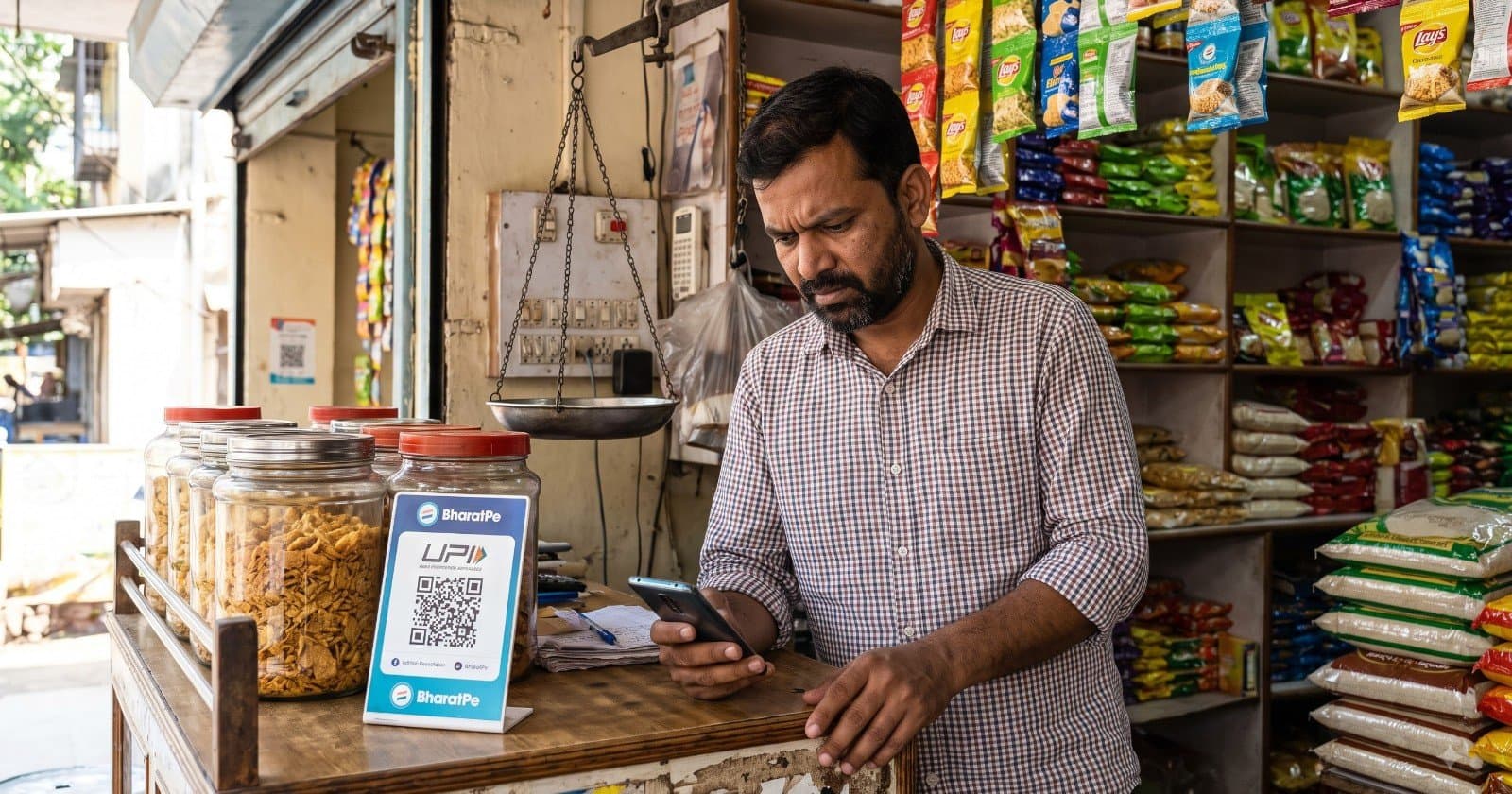
Capital Insider spoke with merchants in Chandni Chowk, Chawri Bazar and Colaba about how businesses that regularly accept UPI are viewing the change.
An electronic vendor told Capital Insider that the market caters to more than one lakh customers and said some customers could move back towards cash if digital payments became more expensive for merchants.
That is a merchant expectation, not an established market outcome. But it captures one of the questions that will only be answered once MDR begins affecting actual settlements.
A saree vendor raised another issue.
“It’s not about big sellers only,” he said.
A single saree can cost between ₹1,500 and ₹4,000, he explained, meaning an ordinary sale can cross the ₹2,000 threshold even though he does not consider himself a big businessman.
For such merchants, the threshold is not necessarily a proxy for business size. It can simply be a consequence of what they sell and the value of an ordinary transaction.
Whether merchants absorb the fee, change prices or influence how customers pay will depend on their margins and payment mix.
The ₹2,000 threshold creates a behavioural question
The most important issue may not be the 0.4% rate itself, but the threshold at which it begins.
Once an eligible payment crosses ₹2,000, the UPI MDR applies to the transaction value. A ₹10,000 transaction therefore attracts ₹40 in MDR; the fee is not charged only on the ₹8,000 above the threshold.
Koustubh Sharma, a credit-risk analyst, fintech researcher and industry observer, describes this as a behavioural “cliff”.
Splitting a ₹3,000 purchase into two ₹1,500 transactions would save a merchant ₹12, but it would also require cooperation from the customer and an additional payment step. Sharma expects that kind of transaction splitting to remain limited.
His larger concern is whether merchants begin changing how they accept higher-value payments.
That possibility has already surfaced in the market. Petrol pump dealers in Madhya Pradesh have announced plans to stop accepting UPI payments above ₹2,000 from October 16, according to media reports.
Fuel falls under the separate ₹5 MDR category, making the development notable even though it does not directly reflect the standard 0.4% charge.
“What made UPI work is that one QR code was accepted everywhere for any amount,” Sharma said. “The risk is that acceptance becomes conditional.”
The significance is larger than the fee itself. UPI’s value to merchants and consumers has partly come from its uniformity. If higher-value transactions begin moving to different payment methods, the system could remain technically ubiquitous while becoming less uniform in practice.
Where the MDR money goes
The new UPI MDR creates a revenue pool across the payment chain rather than for a single company.
Under the standard distribution framework, 40% of the MDR goes to the issuing bank, 30% to the acquiring bank, 20% to the UPI app and 10% to the app’s bank partner.
On a ₹10,000 transaction generating ₹40 in MDR, that translates into ₹16 for the issuer, ₹12 for the acquirer, ₹8 for the app and ₹4 for the bank partner.
That leaves another question: where does the infrastructure underneath the payment chain earn?
S. Anand, Founder and CEO of PaySprint, told Capital Insider that the economics reaching infrastructure providers can be considerably smaller than the headline MDR suggests.
“Less than most people assume,” Anand said.
He noted that the standard distribution does not contain a separately named share for the infrastructure layer providing APIs, reconciliation and fraud-related services.
“At PaySprint, we are paid by the banks and PSPs we power, not by the transaction,” he said.
The distinction matters for the broader fintech market. MDR creates a direct revenue pool for defined payment participants, but companies supporting the infrastructure underneath them do not automatically receive a transaction-level share.
MDR may not be the biggest fintech opportunity
For Anand, the more important commercial opportunity lies around the payment.
“MDR is the floor, not the future,” he said.
He points to identity verification, escrow, credit, compliance and other services that sit around payments as potential revenue pools for financial infrastructure companies.
“The real revenue sits around the payment, not in it,” Anand said.
The argument reflects a broader shift in fintech economics. Once the basic payment itself becomes inexpensive and ubiquitous, the commercially valuable layer can move towards the services required to make transactions safer, compliant and useful to businesses.
For infrastructure providers, that can include verification, reconciliation, fraud controls and compliance.
The cost of running UPI did not disappear
The debate around MDR often begins with whether UPI was ever truly “free”.
Anand’s view is that it was not.
“The misconception is that UPI was free. It was never free, it was subsidised,” he said.
The payment still required switching, settlement, fraud monitoring and customer support. The zero-MDR framework changed who bore those economics; it did not eliminate the underlying cost.
The Department of Financial Services has cited an industry estimate of around ₹20,000 crore a year for the cost of running the UPI ecosystem.
That is an industry estimate, not an audited NPCI cost figure.
The new MDR framework introduces a commercial revenue stream into a payment system that has reached enormous scale. The government has also allocated ₹2,000 crore for FY2026-27 towards incentives linked to low-value BHIM-UPI and RuPay debit-card transactions.
A separate mechanism provides for 5% of MDR collections to go towards a fund for small merchants, with the operating framework to be developed in consultation with the RBI.
The policy is therefore attempting to introduce revenue without applying a broad fee to everyday low-value digital payments.
The digital trail has a value of its own
Sharma views the issue through the credit market as well.
For lenders assessing small businesses, digital receipts can provide evidence of sales and cash flow. If higher-value transactions increasingly move away from UPI and into cash, some of that transaction-level information becomes less visible to lenders.
“For a lender the digital trail is the collateral,” Sharma said. “Cash-flow underwriting for small businesses runs on bank and UPI receipts.”
That does not mean a merchant moving one payment to cash suddenly loses access to credit. The issue is the quality and completeness of transaction data at scale.
If digital receipts become less representative of actual sales, lenders may have less information with which to assess business cash flows.
The effect will also depend on whether merchants shift to cash, bank transfers, cards or other digital channels.
The GST question
The GST treatment creates another layer for merchants.
An 18% GST applies to the MDR service fee, not to the underlying customer transaction.
Deni Shah, Head of Customs & International Trade at Bhuta Shah & Co LLP, said the distinction is important when calculating the actual cost.
“The 18% GST will apply only to the MDR fee and not to the customer transaction amount,” Shah said.
For a ₹10,000 eligible payment, the ₹40 MDR produces ₹7.20 in GST.
For a concessional ₹5 MDR, GST on the fee would be ₹0.90. At the ₹300 MDR cap, the maximum GST on the MDR would be ₹54.
The actual economic impact depends on the merchant’s tax position.
GST-registered businesses that satisfy the applicable conditions may generally claim input tax credit on eligible business expenses. For businesses that cannot recover the GST, including certain composition-scheme, exempt or unregistered businesses, the tax can become an operating cost.
The headline 0.4% therefore does not tell the entire merchant-cost story.
How large could the MDR revenue pool become?
There is no single verified public number for annual MDR collections.
The framework contains different rates, exemptions, caps and merchant categories, making a simple percentage applied to total UPI or P2M value unsuitable as a definitive calculation.
Financial institutions have produced different estimates.
Citi estimates annual revenue potential of around ₹16,000–17,000 crore. JPMorgan has estimated roughly ₹17,000 crore, while UBS has placed the potential at ₹10,000–15,000 crore. Reuters reported Citi’s estimate of ₹160–170 billion in annual revenue potential.
Bernstein has projected a higher revenue pool of around ₹27,000 crore by FY2028 under its assumptions.
The range is itself revealing.
The headline MDR is 40 basis points, but the effective rate across the broader P2M ecosystem will be lower because transactions below ₹2,000, eligible P2PM merchants, concessional categories and capped transactions do not all generate the full 0.4%.
No audited industry disclosure yet establishes the eventual blended take rate.
Actual collections will therefore matter more than any pre-launch estimate.
What consumers will see
For consumers, the immediate change is less visible.
The government has stated that consumers will not be charged MDR. UPI apps are not permitted to impose platform or hidden charges on users, and banks have been advised to ensure that UPI MDR is not passed on to customers.
But preventing a direct consumer fee does not eliminate the underlying economic cost.
The merchant still faces the MDR on eligible transactions.
A business may absorb the cost, change pricing, alter payment preferences or continue without making a change. The response is likely to vary by sector, margins and customer behaviour.
The first evidence will come after the framework goes live.
The first real test begins October 15
UPI’s first challenge was adoption.
It succeeded by making digital payments simple enough to become routine across India’s retail economy.
The next challenge is economics: whether the system can create a sustainable commercial revenue layer without changing the merchant behaviour that helped make it ubiquitous.
The merchants Capital Insider spoke with illustrate the tension. An electronic vendor is thinking about whether customers may return to cash. A saree seller is questioning why a ₹2,000 threshold should distinguish a small retailer from a large business when an ordinary sale can cross it.
Anand’s infrastructure perspective raises a different question: whether the revenue created at the payment layer will flow far enough down the technology stack.
Sharma’s credit-risk lens highlights the value of the digital transaction trail itself.
Shah’s tax analysis shows that the actual cost to merchants depends on more than the headline 0.4% rate.
The policy therefore creates more than a new fee.
It creates a new set of incentives around how merchants accept payments, how payment companies monetise transactions, how infrastructure providers are compensated and how lenders observe small-business cash flows.
The answers will become visible only once the money starts moving under the new rules.
For consumers, the QR code may look exactly the same.
For merchants, banks, fintechs and the infrastructure supporting them, the economics behind it will not.
Reporting & Methodology
This article combines official government and NPCI material, UPI transaction data, financial-institution estimates, expert commentary and original reporting by Capital Insider with merchants in Chandni Chowk, Chawri Bazar and Colaba.
Comments from S. Anand, Founder and CEO, PaySprint; Koustubh Sharma, credit-risk analyst, fintech researcher and industry observer; and Deni Shah, Head of Customs & International Trade, Bhuta Shah & Co LLP, were provided to Capital Insider in response to questions concerning UPI monetisation, merchant behaviour, credit risk and GST.
Expert comments are presented as attributed views and analysis, not as independent findings by Capital Insider.
Merchant comments are attributed to the individuals who provided them. Statements about customers moving towards cash are presented as merchant expectations rather than established market outcomes.
Revenue estimates are attributed to the financial institutions that published them. Capital Insider has not presented a definitive annual UPI MDR collection figure because publicly available data does not provide sufficient transaction-level detail across all rates, exemptions and caps.
Also Read :UPI payments gain ground in India’s capital markets as broker transactions rise