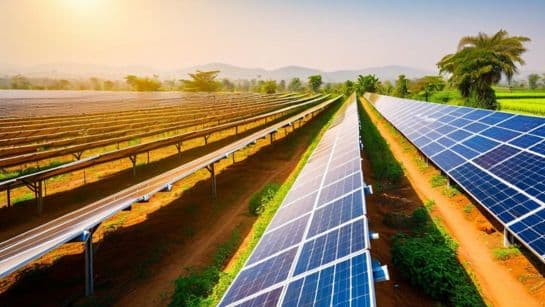
Vikram Solar is scaling up beyond manufacturing to position itself as a tech-driven force in the renewable energy ecosystem.
India, especially in the last decade, has seen an upward growth trend in the renewable energy sector. The sector is now entering a decisive phase with solar power becoming the backbone of the country’s clean energy strategy. With the government aiming for 500 GW of non-fossil fuel capacity by 2030, solar energy is expected to carry much of that load. Until 2024, India’s renewable energy capacity stood at 191 GW, with solar contributing over 82 GW, a figure expected to rise sharply in the coming years.
Against this backdrop, companies like Vikram Solar are increasingly moving beyond panel manufacturing and into integrated energy solutions.
Vikram Solar expands beyond traditional manufacturing
What began as a modest photovoltaic (PV) module manufacturer in 2009 has grown into one of India’s major solar companies, with manufacturing capacity now reaching 4.5 GW. The company has laid out ambitious plans to scale this up to 15.5 GW by 2027, reflecting the rapid pace of growth in India’s solar sector. Its expansion includes new manufacturing facilities in Tamil Nadu and upgrades to existing operations in West Bengal. This scale-up is seen as part of a larger industry trend, where domestic solar manufacturers are racing to reduce import dependency and strengthen India’s supply chain.
Vikram Solar is investing in advanced solutions such as bifacial modules, N-type cells, and heterojunction technology (HJT), all aimed at improving energy efficiency and output. The company is also building a Centre of Excellence to focus on digital manufacturing systems and predictive maintenance tools
Battery storage could shape the next phase.
Perhaps the bigger signal lies in energy storage. Vikram Solar has announced plans for a 1 GWh solid-state battery facility, scalable to 5 GWh, showing how storage is becoming central to renewable infrastructure.
As solar adoption grows, storing that energy efficiently will be critical. For India’s renewable future, companies that combine generation with storage may hold the strongest long-term advantage.