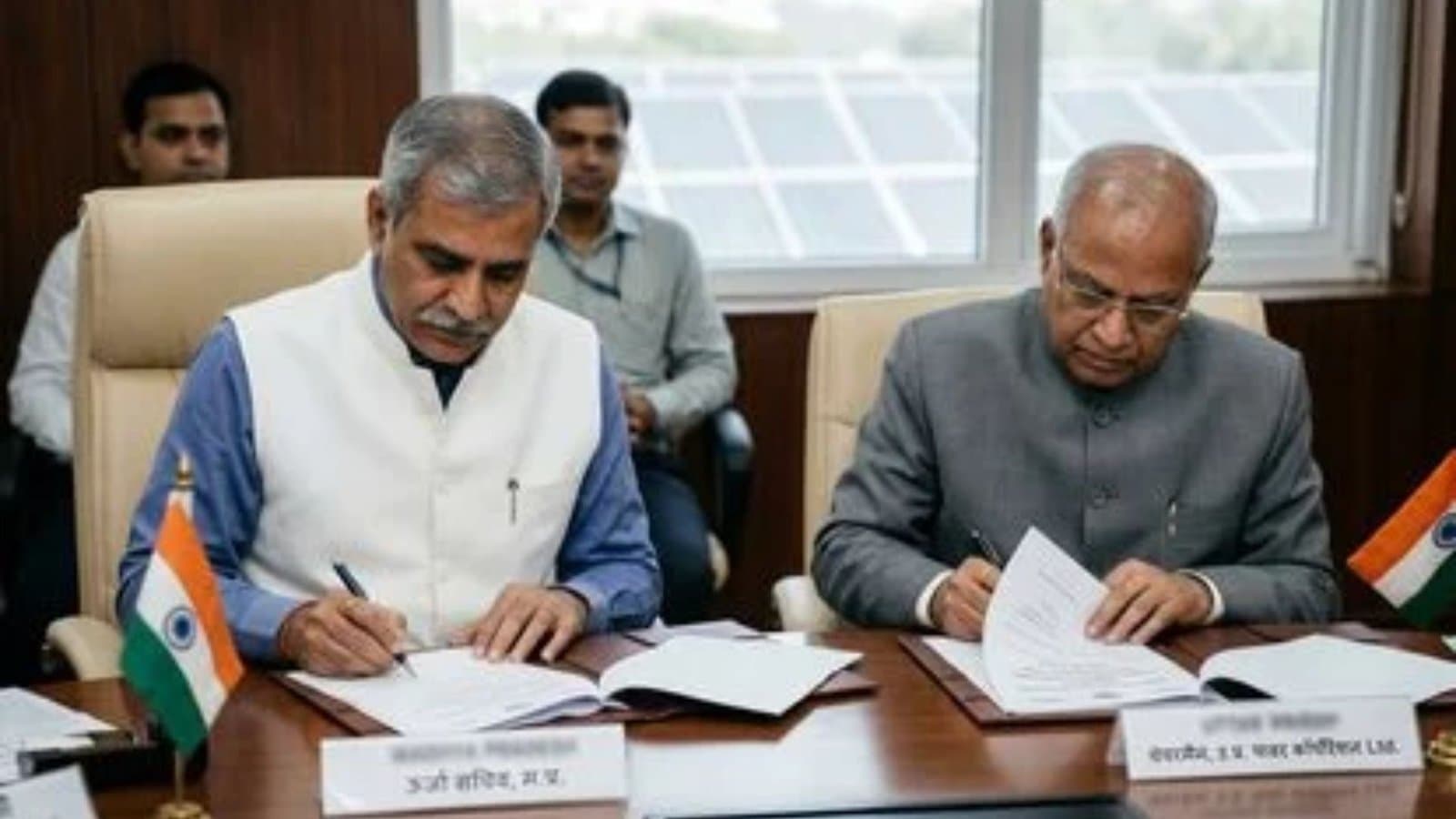
States plan joint approach to peak power needs through seasonal demand balancing and power banking.
Uttar Pradesh and Madhya Pradesh have agreed to coordinate power procurement and explore medium-term power banking, with the two states planning to procure 2,000 MW of peak power capacity through competitive bidding. The initiative aims to make better use of available electricity resources while managing seasonal variations in demand.
The memorandum of understanding (MoU) was signed between Madhya Pradesh Power Management Company Ltd (MPPMCL) and Uttar Pradesh Power Corporation Ltd (UPPCL). MPPMCL Chief General Manager (Non-Conventional Energy) G S Khanooja and UPPCL Chief Engineer (PPA) Manish Dwivedi signed the agreement.
Different demand cycles drive the partnership.
A key factor behind the arrangement is the difference in the periods when the two states experience their highest electricity demand. Madhya Pradesh typically sees stronger power consumption between October and March, largely linked to the rabi agricultural season. Uttar Pradesh, meanwhile, experiences higher demand during the summer and kharif season, broadly between April and September.
The contrasting demand cycles could allow electricity generation capacity to be used more efficiently. Power available during periods of relatively lower demand in one state could potentially support requirements in the other, reducing the need for expensive short-term purchases.
Competitive procurement of 2,000 MW.
Under the proposed framework, Uttar Pradesh and Madhya Pradesh will move towards competitive procurement of 2,000 MW of peak power capacity. The arrangement is intended to support long-term resource planning and improve the utilisation of generation assets.
The initiative also includes discussions around firm power banking. Such an arrangement could allow the states to manage electricity availability across different demand periods while providing greater flexibility to their power systems. The proposed cooperation comes as state power systems face the challenge of balancing growing electricity demand with the increasing integration of renewable energy.
Power banking can provide additional flexibility when renewable generation varies according to weather and time of day. The two states are therefore also looking at the arrangement through the lens of grid stability, energy security, and better resource utilisation. The initiative, supported by consultants Mercados, is expected to attract around ₹10,000 crore in investment in the power and renewable energy sectors, according to the reported details.
The MoU reflects a broader effort to address electricity requirements through cooperation between states rather than relying solely on short-term procurement. By aligning their seasonal demand patterns, Uttar Pradesh and Madhya Pradesh aim to improve planning, manage peak requirements, and use power resources more efficiently.