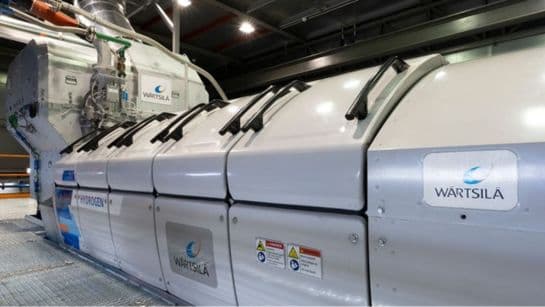
It has risen as the world’s first large-scale hydrogen-powered engine connected to Spain’s electricity grid, marking a step forward for cleaner and more flexible energy systems.
In a major breakthrough for the clean energy sector, Finnish energy Technology Company Wärtsilähas successfully tested what it claims is the world’s first large-scale engine running entirely on 100% hydrogen. The trial has taken place at the company’s Bermeo facility in northern Spain, where the hydrogen engine was connected directly to the national power grid. Unlike earlier “hydrogen-ready” systems, this demonstration proved that large industrial engines can operate entirely on hydrogen under real-world grid conditions.
The development could become a crucial piece in solving one of renewable energy’s biggest challenges: inconsistency.
Why hydrogen matters for renewable power?
Solar and wind power have expanded rapidly across Europe, but both rely heavily on weather conditions. That makes energy storage and backup systems essential. Hydrogen is increasingly being seen as one of the most viable long-duration energy storage options. Excess renewable electricity can be used to produce green hydrogen, which can then be stored and converted back into electricity when needed.
This latest test shows how hydrogen-powered combustion engines could serve as flexible backup systems when renewable output drops. Unlike batteries, hydrogen storage can hold energy for much longer periods, making it particularly useful for large-scale grids.
Spain’s growing hydrogen ambitions.
Spain has been aggressively building its hydrogen infrastructure as part of its wider clean energy strategy. The country is aiming to become one of Europe’s leading green hydrogen hubs, supported by major pipeline and storage investments. This makes Spain a practical testing ground for technologies like Wärtsilä’s hydrogen engine, especially as renewable energy contributes a larger share of its electricity mix.
Despite the milestone, hydrogen energy still faces hurdles. Production costs remain high, and infrastructure for storage and transport is still developing. But the successful grid-connected test suggests hydrogen may move from theory to practical application faster than expected.
For energy markets worldwide, this could be a glimpse into the future of reliable, low-carbon power generation.