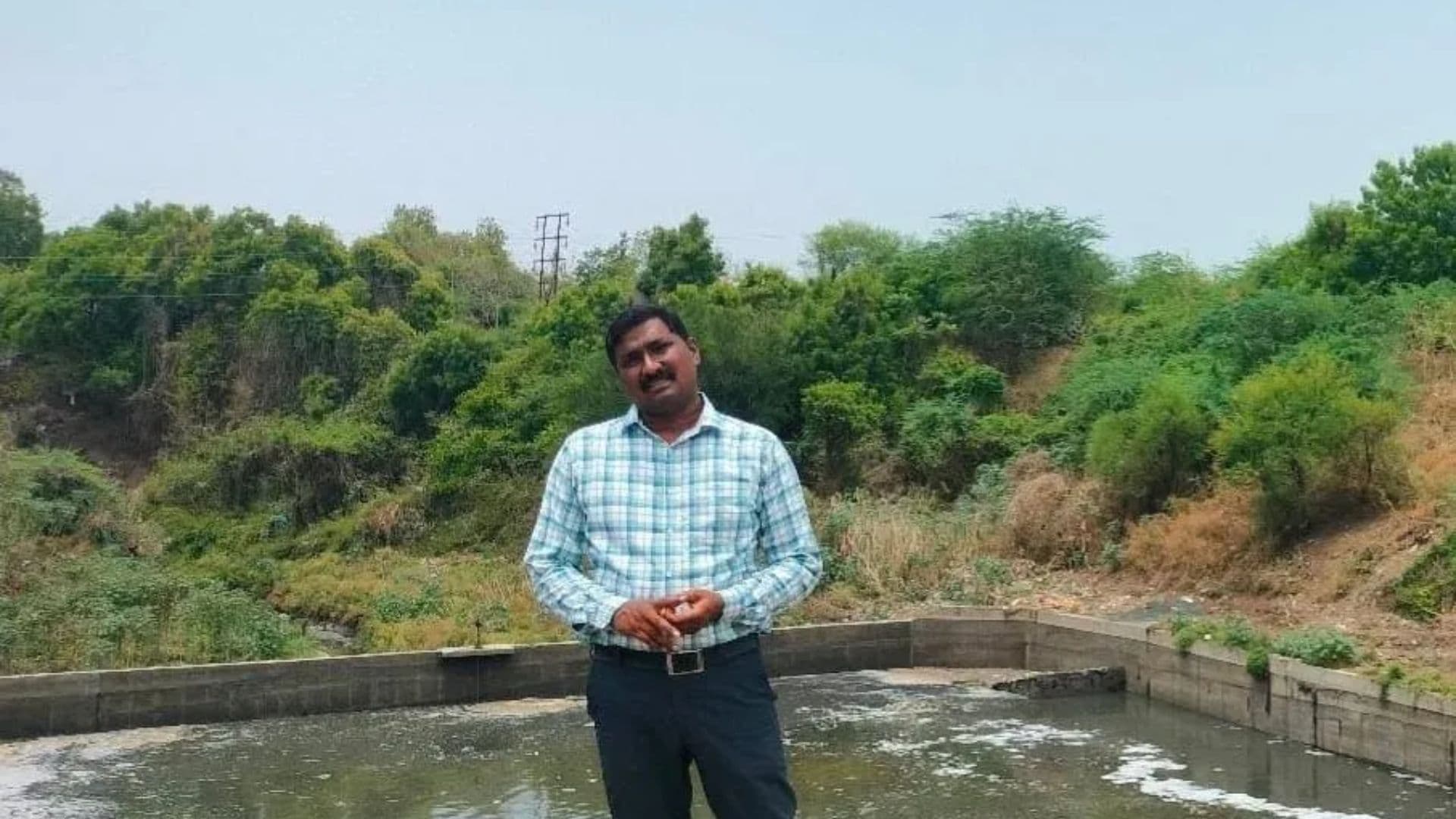
He gave up a stable GIS career in Pune to return to drought-prone Latur, where he has spent 14 years combining satellite mapping, traditional knowledge, and community training to solve one of Maharashtra’s most persistent crises
Parmeshwar Poul recalls the weight of the brass vessels he had to carry as he was growing up. The Khandali Village resident used to wake up early in the morning to get ready to collect water from the village well. Despite the hitches of leaving home in 2011 and going to Pune to make a career in Geographic Information Systems, he couldn’t shake off his memories of home.
A year later, he was finally back in Khandali.
What He Built When He Returned
When Poul returned, he didn’t just bring knowledge, he brought new tools. He used satellite maps and hydrological surveys in villages where wells dried up year after year. For his MPhil, he mapped out rooftops in Ahmedpur so he could design rainwater harvesting systems for families who only got water once every eight days. His PhD took things even further—123 villages included, blending science with old wisdom to guide what crops to plant and how to use groundwater wisely.
The Scale of the Impact
At Swami Ramanand Teerth Marathwada University, Poul helped build over 300 rainwater harvesting structures—ponds, check dams, and percolation systems. Workers cleared almost 334,000 cubic meters of silt from seven lakes in Nanded and Nashik, adding space for about 334 million more liters of water. Thanks to this work, the university stopped relying on costly water tankers during scorching summers and saved a lot of money each year.
He also developed the C-Jal filter, a low-cost borewell rainwater purification system built entirely from locally available materials that has since been installed across villages and towns.
Through the Jaldut programme, Poul has trained around 160 water ambassadors in Nanded district alone, turning conservation from an expert-driven exercise into a community movement.