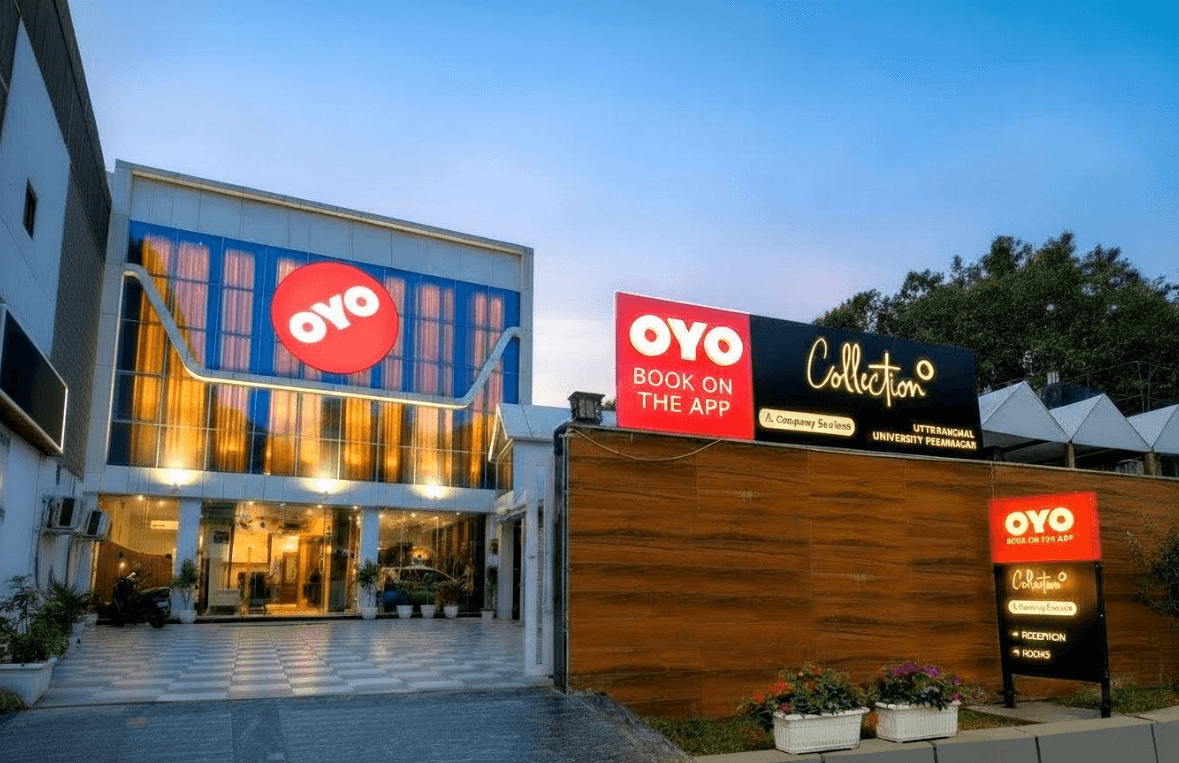
The OYO IPO is not simply a return to the market. It is a test of whether the company has changed its business enough to deserve one. Revenue, EBITDA and reported profit have improved sharply, but a large tax credit, a shrinking Indian business and a much more global cost structure complicate the turnaround story.
What Has Changed Ahead of the OYO IPO?
OYO began as an India-focused budget-hotel aggregator. It is now a global, multi-brand hospitality platform operating across 35 countries, with more than 80% of revenue coming from outside India. The Economic Times reported the global shift.
The biggest change is the acquisition of G6 Hospitality, the owner of Motel 6 and Studio 6 in the United States. OYO completed the $525-million acquisition from Blackstone Real Estate in December 2024, adding approximately 1,500 franchised properties across the US and Canada. Blackstone announced the completed acquisition, while Business Standard reported the deal’s expected EBITDA impact.
That deal changed OYO’s centre of gravity. North America became the largest contributor to the group’s FY26 growth, with G6 making its first full-year contribution. TradingView reported the North America contribution.

OYO has also moved upmarket. It is expanding premium and company-serviced hotels, including in the UK through Sunday Hotels and Belvilla. Business Standard tracks the UK expansion. The company says it now runs an asset-light, multi-brand strategy, with 67% of bookings coming through direct channels. Inc42 reported the platform strategy.
The financial improvement
The OYO IPO story is supported by a sharp improvement in Prism’s FY26 financial performance. Prism, OYO’s parent company, reported a 49.7% rise in consolidated revenue from operations to ₹9,358 crore. EBITDA more than doubled to ₹2,594 crore, while gross booking value rose 88.5% to ₹30,683 crore. Kotak Neo reported the FY26 results, and Moneycontrol also reported the revenue and EBITDA growth.
The improvement is not only from acquisitions. OYO says higher business volumes, a stronger premium and company-serviced hotel mix, operating leverage and G6’s full-year contribution all helped. The Economic Times reported the drivers.
But the profit needs context
OYO’s FY26 net profit of ₹994 crore includes a ₹678-crore deferred-tax credit. The Economic Times reported the tax credit. Excluding that credit, reported profit would have been roughly ₹316 crore—materially lower than the headline number.
FY25 profit also benefited from a large deferred-tax credit. Inc42 reported that OYO’s FY25 profit of ₹244.8 crore included a ₹734.1-crore tax credit. Inc42 reported the FY25 tax credit.
A deferred-tax credit is an accounting benefit rather than cash generated by hotel operations. It can improve reported net profit without directly showing stronger underlying operating performance. That means OYO’s reported profit is not yet a clean measure of operating profitability. The EBITDA improvement is more meaningful, but investors should still examine interest, depreciation, tax, and cash flow.
India is no longer the growth engine
OYO’s India business has weakened even as the global business has expanded. India contributed only 16.1% of FY26 revenue, while international markets contributed 83.9%. Precize reported the geographic split. This follows longer-term weakness in the domestic business. In FY24, OYO’s India operational revenue fell 1.4% to ₹5,389 crore from ₹5,464 crore in FY23. The Economic Times reported the India revenue decline.
That creates a strategic question. OYO is listing in India, but most of its growth now comes from overseas markets—especially the United States.
Investors will need to decide whether OYO is an Indian hospitality platform with global operations, or a global hospitality company using Indian public markets to raise capital.
The OYO IPO history
This is OYO’s third attempt at going public.
OYO first filed a DRHP in 2021, seeking to raise ₹8,430 crore, or about $1.2 billion. The application was returned by SEBI in January 2023. The Economic Times reported the first IPO attempt.
The company then took the confidential filing route in December 2025 and filed an updated draft red herring prospectus with SEBI on June 30, 2026. Fortune India reported the updated filing, while The Economic Times reported the confidential filing and SEBI approval.
The June 2026 filing proposed an all-fresh issue of up to ₹6,650 crore, with a possible pre-IPO placement of up to ₹1,330 crore. There is no offer-for-sale component, meaning existing shareholders such as founder Ritesh Agarwal and SoftBank are not selling shares in the issue. The Week reported the IPO structure.
Under the original plan, Prism intended to use ₹4,987.5 crore—nearly 75% of the net proceeds—to repay or prepay borrowings, largely through its Singapore subsidiary, Oravel Stays Singapore. The remainder was earmarked for general corporate purposes. Moneycontrol reported the use of proceeds.
On 21–22 October, reports indicated that Prism was likely to reduce the proposed fresh issue to up to ₹3,350 crore, nearly half the earlier target. The reported rationale is stronger cash generation and an improved balance sheet, with residual debt expected to be repaid over the next two to three years from operating cash flows. The Economic Times reported the likely reduction, and YourStory reported the revised capital plan.
The Valuation Question Behind the OYO IPO
OYO’s valuation has moved sharply.
It peaked at $9 billion in 2021. By 2024, it had fallen to about $2.4–2.5 billion in a private funding round. The Economic Times reported the valuation decline. The company is now reportedly targeting a $6–7 billion valuation for its IPO, though this remains a reported target rather than a confirmed listing valuation. The Economic Times reported the valuation target.
That means OYO is seeking a valuation well above its recent private-market level, though below its 2021 peak.
The case for a higher valuation rests on:
- Higher EBITDA and improving operating leverage.
- A larger global footprint across 35 countries.
- The $525-million G6 acquisition and its US earnings base.
- Premiumisation through brands such as Sunday Hotels and Belvilla.
- A higher share of direct bookings.
- Lower reliance on India.
The case against rests on:
- Tax-credit-supported reported profit.
- Declining Indian revenue and India’s reduced share of the group.
- Integration risk from G6 and the challenge of managing a legacy US franchising business.
- Debt and interest costs, reflected in the IPO’s original debt-repayment focus.
- A valuation still below the 2021 peak but well above the 2024 private round.
- Execution risk in converting global scale into durable free cash flow.
Conclusion
OYO has changed. It is no longer primarily an Indian budget-hotel aggregator. It is a global hospitality platform with a large US business, a growing premium portfolio and much stronger EBITDA.
But its profit story still depends partly on tax credits, and its Indian business is no longer the main growth engine. The reduced IPO size also suggests that the company may need less external capital than it did a few months ago—but it does not erase the question of whether its operating cash flows can sustainably support its debt, expansion and valuation.
Ultimately, the OYO IPO will test whether investors believe Prism has built a sustainable global hospitality business—or simply improved its headline numbers enough to return to the market.
Read More: Spinny Has Filed for an IPO. How Does a Used-Car Platform Actually Make Money?