AI search advertising is becoming a new layer of digital marketing. Brands can now pay to appear beside, below, or within AI-generated answers—but they usually cannot pay an AI model to recommend them.
That distinction matters. A paid AI ad buys visibility. An organic AI citation buys influence. As consumers increasingly ask AI assistants what to buy, where to travel, and which product to choose, brands will need to compete on both.
What AI Search Advertising Actually Buys
AI search advertising is not one product. It includes several formats with different levels of control.
| What a brand buys | What it gets | What it does not get |
| Sponsored ad beside an AI answer | Visibility next to the response | Control over the AI’s recommendation |
| Sponsored follow-up question | A branded prompt that leads to an AI answer | The ability to write the answer |
| Ad inside a shopping carousel | A sponsored product placement | Guaranteed inclusion in the unpaid recommendation |
| Conversational ad unit | A chat-like experience around the ad | Control over the independent AI explainer |
| Organic AI citation | Inclusion in the AI’s unpaid answer | A guaranteed position or ranking |

Google has introduced ad formats inside AI Mode and AI Overviews, including Conversational Discovery ads and Highlighted Answers. These are labelled “Sponsored” and are designed to appear alongside, not replace, the organic response. Search Engine Journal reported Google’s AI ad formats.
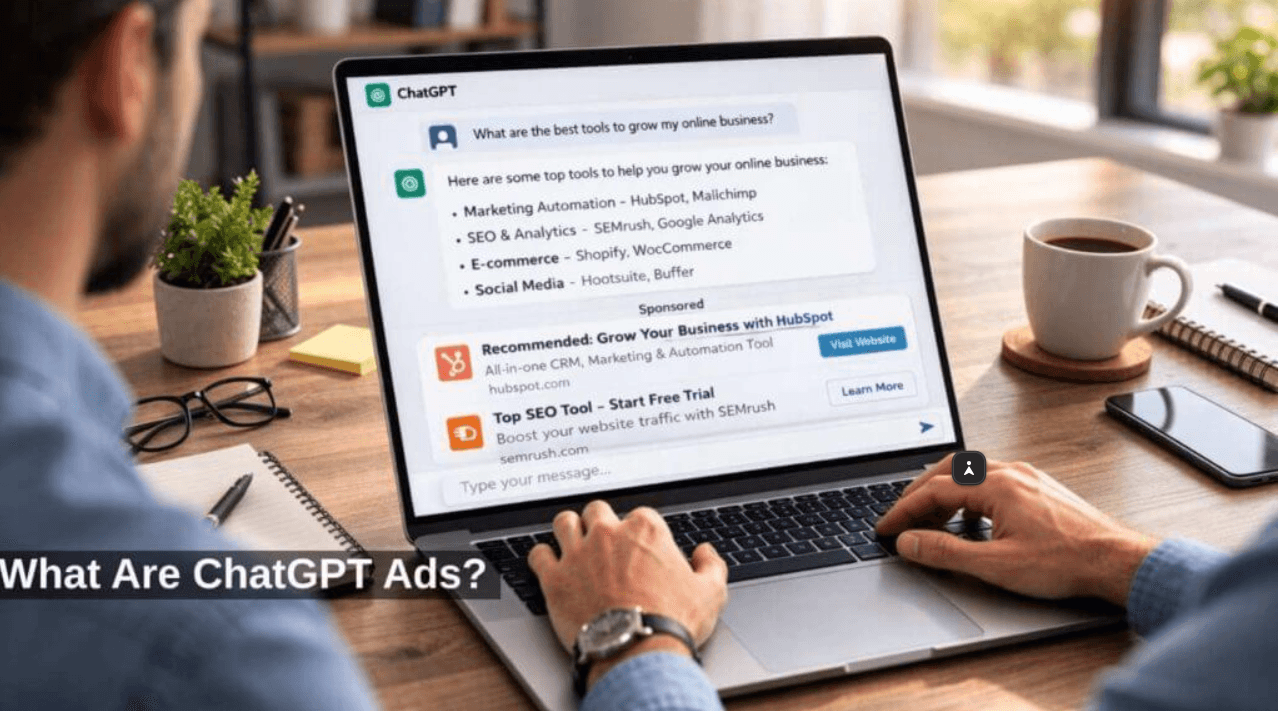
OpenAI began testing ads in ChatGPT for eligible US users in February 2026. ChatGPT’s organic recommendations are generated from product feeds, third-party reviews, editorial roundups, and the open web. Ads appear below the organic answer, are labelled “Sponsored,” and are visually separated from the response. Honeyb AI reported OpenAI’s ad format.
Perplexity tested sponsored follow-up questions and paid media beside answers, but stopped accepting new advertisers in October 2025 and later said it had no plans to pursue advertising further. Aragil reported Perplexity’s ad retreat.
The most important distinction in AI search advertising is between paid visibility and paid recommendation. A brand can pay to appear beside an AI answer. It can sponsor a follow-up question. It can buy a slot in a shopping carousel. But it generally cannot pay the AI to name it as the best option.
This is a major change from traditional search advertising. In classic search, a brand could bid on a keyword and appear above organic results. In AI search, the paid unit is increasingly separate from the answer itself.
Why organic AI visibility matters more
As AI answers reduce the need for traditional search clicks, organic citations are becoming a critical part of AI search advertising strategy.
Google’s AI Mode and AI Overviews can reduce organic click-through rates because users may get their answer without visiting a website. But being cited still matters. Driven Metrics found that cited brands earned 2.2 times more organic clicks than uncited brands on the same AI Overview results. Driven Metrics reported the citation data.
The same analysis found that only 11.53% of AI Mode advertisers were also cited as a source for the keyword they advertised on. That means paid placement and organic citation are separate outcomes. Driven Metrics reported the overlap.
A brand that is only buying ads may get visibility. A brand that is cited may get trust.
Generative Engine Optimisation: The Organic Side of AI Search Advertising
Generative engine optimisation, or GEO, is the practice of improving how often and how favourably a brand appears in AI-generated answers.
Traditional SEO is optimised for rankings on a search-results page. GEO optimises for how AI systems find, interpret, cite, and recommend a brand.
Brands need to optimise for:
- Product feeds and structured data.
- Reviews and ratings.
- Editorial coverage.
- Comparison content.
- Expertise and authority.
- Consistent product information.
- Presence in sources AI systems trust.
The goal is not merely to rank for a keyword. It is to become a source that AI systems are likely to cite when answering a commercial question.
Adobe found that AI-referred traffic to US retail sites grew 393% year over year in the first quarter of 2026. It also found that the average product page scored only 66% on citation readability, suggesting many brands are not yet structured for AI discovery. Adobe reported the GEO opportunity.
AirOps analysed 21,311 brand mentions across ChatGPT, Claude and Perplexity. It found that 85% of brand mentions came from external domains, while only 13.2% came directly from the brand’s own website. Adobe reported the external-source finding.
That means reviews, press coverage, forums, YouTube and third-party comparisons matter as much as a brand’s own website.
Why big brands may benefit first
Large advertisers have several advantages in the early AI-ad market. They have bigger budgets, existing brand recognition, large product catalogues, established review volume and agency relationships. They can test multiple formats across Google, ChatGPT and other AI platforms.
OpenAI’s early ChatGPT advertising testers included Target, Williams-Sonoma, Albertsons, Adobe and WPP. Later reporting added HelloFresh and Amazon’s Audible. Honeyb AI reported the early advertisers.
Google’s AI Mode ad tests also favour advertisers with strong commercial intent and established search presence. Driven Metrics found that AI Mode ad presence rose from 24.33% for keywords under $2 CPC to 53.56% for keywords at $10 or more. Driven Metrics reported the ad-frequency data.
That suggests high-value commercial categories will attract paid placements first.
Why small D2C brands may still win
But AI search advertising could also help smaller brands.
A D2C brand may not be able to outspend a large incumbent on advertising. But it can compete on:
- Product quality.
- Customer reviews.
- Niche expertise.
- Comparison content.
- Creator coverage.
- Editorial mentions.
- Transparent product information.
If an AI model recommends a smaller brand because it has better reviews, clearer product data, or stronger independent coverage, that visibility can be more valuable than a paid ad. This is especially important in categories where consumers compare options: skincare, supplements, home appliances, fashion, travel, software, and consumer electronics.
Measuring the Impact of AI Search Advertising
AI advertising also creates a measurement challenge.
In traditional search, brands can track clicks, impressions, cost per click, and conversions. In AI answers, the user may see a recommendation, ask follow-up questions, compare products, and only later visit a website. That makes attribution harder.
Brands will need to measure:
- AI citations.
- Branded-search lift.
- Direct traffic.
- Referral traffic from AI platforms.
- Conversion rates from AI-referred sessions.
- Share of voice in AI answers.
- Impact on organic search performance.
- Incremental sales, not just clicks.
The risk for brands
AI search advertising also creates brand-safety and trust risks.
If an AI answer recommends a competitor, a paid ad below it may look weak. If a sponsored placement appears next to a negative answer, it may damage the brand. If users cannot distinguish between organic advice and paid placement, trust may fall.
Google says its AI Mode ad formats will continue to be labelled “Sponsored” and appear alongside, not in place of, the organic response. Search Engine Journal reported Google’s labelling policy.
OpenAI says ads do not influence the answers ChatGPT gives, and that conversations are kept private from advertisers. Honeyb AI reported OpenAI’s policy.
But perception matters. If consumers believe AI recommendations can be bought, the value of AI-generated advice could decline.
Conclusion
AI search advertising is not simply about buying recommendations; it is about securing visibility in a new layer of consumer discovery. The winners will not necessarily be the brands with the largest advertising budgets. They will be the brands that can be found, understood, trusted, and recommended by AI—before a user ever clicks an ad.
Read More: OYO IPO: What Did OYO Change to Earn Another Shot at the Market?