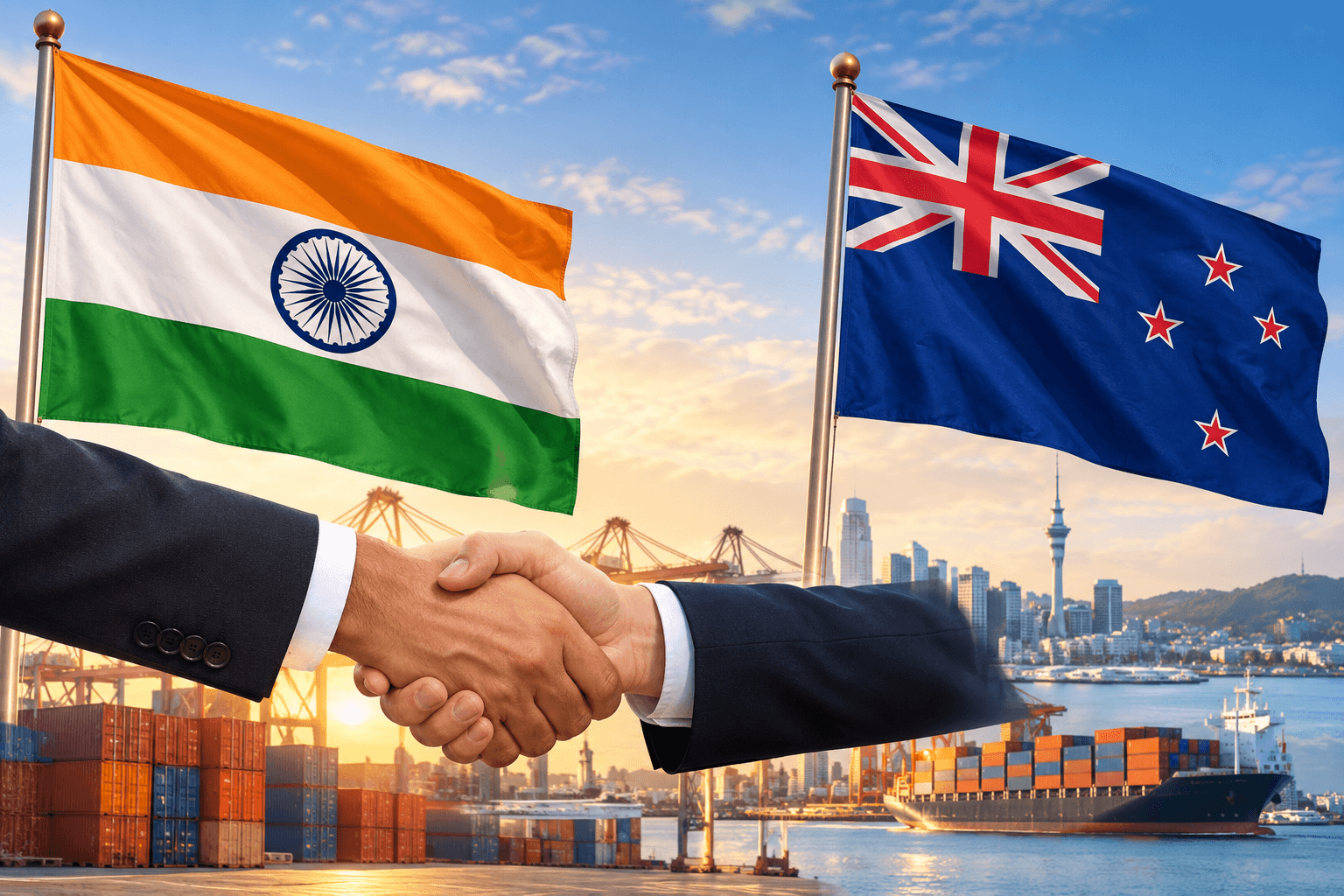
NEW DELHI, October 22, 2026: The India-New Zealand FTA (Free Trade Agreement) has entered into force, opening new opportunities for Indian exporters by providing zero-duty access to the New Zealand market across all tariff lines covering Indian exports. The agreement, effective from October 20, is aimed at strengthening trade, investment and services ties between the two countries.
The agreement could benefit Indian manufacturers, exporters, pharmaceutical companies and service providers by improving their competitiveness in New Zealand and creating opportunities to expand into a developed overseas market.
Textiles, leather and engineering goods among key beneficiaries
The removal of New Zealand’s import tariffs on Indian exports could benefit several labour-intensive and manufacturing sectors, including textiles and apparel, leather and footwear, gems and jewellery, engineering goods and processed food.
New Zealand’s peak tariffs of up to 10% on affected products have been eliminated under the agreement, potentially allowing qualifying Indian goods to become more price-competitive.
For Indian exporters, the gains will depend not only on tariff reductions but also on their ability to meet product standards, maintain competitive pricing and establish distribution networks in New Zealand.
Micro, small and medium enterprises (MSMEs) could also benefit if they are able to use the agreement to diversify export destinations and reduce dependence on a limited number of overseas markets.
Pharmaceuticals and services gain new opportunities
The agreement also creates opportunities for India’s pharmaceutical and medical-device industries. New Zealand’s acceptance of inspection approvals from regulators including the US Food and Drug Administration, the European Medicines Agency, the UK’s Medicines and Healthcare products Regulatory Agency and Health Canada is intended to streamline aspects of market entry for eligible products.
The services sector is another important component of the agreement. Indian companies and professionals could gain improved access to opportunities in information technology, professional services, construction, tourism and other covered areas.

The pact also provides for up to 5,000 Temporary Employment Entry visa holders from India in New Zealand at any one time, subject to eligibility and immigration requirements.
A separate working-holiday scheme for Indian nationals aged 18 to 30, capped at 1,000 places annually, is to be introduced within two years of the agreement taking effect.
Eligible Indian graduates will also receive expanded post-study work opportunities under the agreement’s provisions, with specific eligibility conditions applying.
New Zealand investment commitment
New Zealand has committed to facilitate USD 20 billion in investment into India over 15 years, with potential opportunities in agriculture, manufacturing, infrastructure and startups.
The commitment is intended to support deeper commercial ties, although actual investment flows will depend on project development, business decisions and implementation.
The two countries have set an aspirational target of doubling bilateral trade in goods and services to NZ$7 billion by 2030, equivalent to approximately Rs 35,000 crore under the Indian government’s stated estimate.
What does the agreement mean for Indian farmers and consumers?
The deal does not open every part of India’s domestic market without restrictions. India has excluded sensitive products, including dairy, sugar and several agricultural commodities, from tariff concessions.
Access for certain New Zealand products, including apples, kiwifruit and Manuka honey, will be governed by calibrated arrangements involving tariff-rate quotas, minimum import prices, seasonal windows and safeguards.
These provisions are intended to balance greater trade with protection for sensitive domestic sectors. The actual impact on Indian producers and consumers will depend on the terms applicable to individual products and how trade flows develop after implementation.
India-New Zealand FTA: Implementation will determine the gains
The agreement offers Indian exporters a fresh opportunity to expand in New Zealand, but tariff elimination alone does not guarantee higher sales.
`Businesses will need to understand rules of origin, customs documentation, product certification and regulatory requirements to qualify for preferential treatment.
For smaller exporters, access to market information, reliable logistics and overseas distribution partners could prove as important as lower tariffs.
The coming months will indicate whether the agreement translates into a meaningful increase in exports, investment and employment. For India, the key test will be whether businesses can turn improved market access into sustained commercial gains.