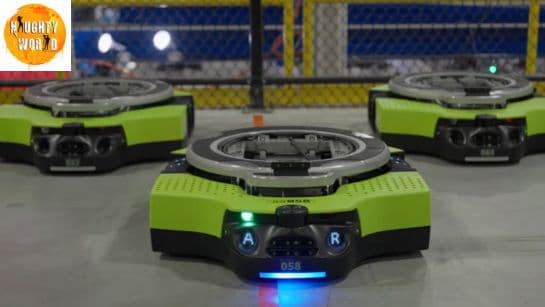
Advanced warehouse automation goes beyond repetitive tasks, as Amazon introduces a robot capable of understanding natural-language commands.
Amazon has now unveiled an upgraded version of its autonomous warehouse robot, Proteus. This has marked a significant and a bold step forward in the evolution of artificial intelligence (AI) and robotics within logistics operations. Unlike traditional warehouse robots that follow pre-programmed instructions, the new Proteus has been designed for understanding conversational language, enabling employees to communicate with it much like they would with a colleague.
Proteus is expected to handle physically demanding tasks, such as transporting heavy containers and moving inventory across fulfilment centres, thereby reducing the need for manual handling.
Roll out the latest version of Proteus.
The latest version of Proteus represents a notable departure from earlier warehouse robots. While previous systems operated within designated areas and followed fixed instructions, the upgraded robot can determine task priorities, plan routes, and execute assignments based on verbal prompts from employees. This allows it to operate more flexibly across warehouse environments. According to Amazon, workers can simply communicate what needs to be done, while the robot independently manages navigation, timing, and execution. Such capabilities demonstrate how artificial intelligence is increasingly being integrated into industrial automation beyond routine mechanical functions.
One of the primary objectives behind the deployment of Proteus is to improve workplace safety by taking over physically strenuous tasks. The robot is designed to move heavy carts and containers while safely navigating around employees, helping reduce the physical demands associated with warehouse operations. Rather than operating separately from humans, newer robotic systems are being developed to work alongside employees in shared environments.
What this means for the future of logistics?
The introduction of AI-enabled robots such as Proteus highlights the rapid transformation taking place across global supply chains. As e-commerce companies continue to process larger volumes of orders, intelligent automation is becoming a critical tool for improving speed, accuracy, and operational resilience. While debates around automation and employment continue, the latest generation of warehouse robotics suggests that the future may be centred on collaboration rather than replacement. By combining human decision-making with AI-driven efficiency, companies are exploring new ways to modernise operations while maintaining a human workforce.
As artificial intelligence becomes increasingly embedded in industrial environments, technologies like Proteus offer a glimpse into how warehouses of the future may function—where humans and intelligent machines work side by side to meet the growing demands of the digital economy.