Often the startup founders start with complete ownership, but after successive funding rounds, they steady reduce their stake. Read on to know more.
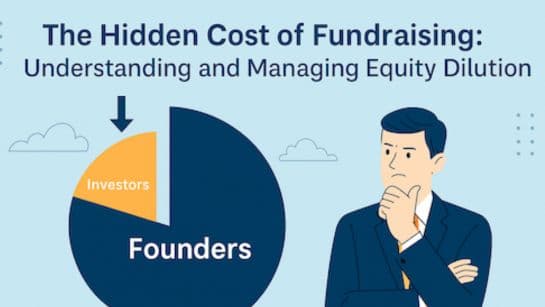
Several startup founders think it is a milestone when they secure venture capital (VC).Funding [internal link of website] helps in bringing the resources, talent, and market expansion opportunities. However, every investment round comes with a cost, which is called dilution. Usually, a founder starts with 100 per cent of ownership, but as the business reaches a major exit, the figure can fall to as little as 10% to 15%. Though this can be a common outcome in venture-backed startups, the psychological and financial implications are often misunderstood.
More about the dilution timeline.
Dilution happens when new shares get issued to investors, employees, or advisors. As the ownership gets distributed among more stakeholders, founders can see their percentage stake declining. As per the data from Carta’s Founder Ownership Report, the median founding team retains roughly 56% ownership after the seed stage and around 36% after Series A funding. By Series B, founder ownership often falls close to 23%, with further reductions occurring through later rounds. Industry also plays a crucial role here. Founders in software and AI companies generally retain larger ownership stakes than those in capital-intensive sectors like manufacturing or hardware.
Experience has a crucial role to play in negotiations.
The dilution experience for founders may not be the same for everyone. First-time founders often surrender larger portions of equity because they have limited experience negotiating valuations, investor rights, and option pools. Repeat founders, on the other hand, typically secure stronger terms and raise capital more efficiently. Investors can frequently consider experienced entrepreneurs as lower-risk bets, giving them greater leverage during fundraising discussions. This difference can majorly impact long-term ownership outcomes. The numbers can be startling. A founder who starts with complete ownership may see that stake reduced to 15% or 20% after multiple funding rounds. However, a company that may take a decade to build and reaches a valuation of $1 billion can still create substantial wealth for founders, even after heavy dilution. A 15% stake in such a business can be worth around $150 million before taxes and other considerations.
How can founders prepare?
Founders can reduce unnecessary dilution by understanding financing structures, negotiating valuations carefully, modelling future fundraising scenarios, and planning employee stock option pools strategically. Knowing how each funding round affects future ownership can help in preventing surprises later. Founder ownership remains an important measure of control and personal incentive. However, fixation on percentage alone can be misleading.
The uncomfortable reality of venture capital is that founders rarely keep most of their company. But if dilution helps transform a startup into a billion-dollar enterprise, a smaller percentage of a much larger outcome can ultimately be the more valuable position to hold.