Quick commerce apps are not making money simply by delivering groceries faster or cheaper. From Blinkit to Zepto, Swiggy Instamart and Flipkart Minutes, the real path to profit lies in advertising, in-house brands, denser dark-store networks, larger shopping carts, and better use of each delivery run.
This brings us to a bigger question: can these apps actually turn a profit from delivering groceries in 10 minutes, or are they gradually becoming advertising and retail companies that happen to deliver quickly?
The Core Thesis
Quick commerce apps cannot become profitable simply by delivering packages faster or cheaper. Their financial survival depends on everything around the delivery: selling advertising to brands, launching private labels, increasing orders per dark store, batching nearby deliveries, and persuading customers to build larger, higher-value carts.
The official financial disclosures point to an industry still in transition. Eternal’s Q4FY26 shareholders’ letter reported consolidated adjusted revenue of ₹17,680 crore, B2C NOV of ₹26,880 crore, and consolidated adjusted EBITDA of ₹429 crore across its businesses, including Blinkit. Eternal’s Q4FY26 shareholders’ letter does not, however, mean that every component of Blinkit’s unit economics is profitable.
In Q1FY27, Eternal reported consolidated adjusted revenue of ₹20,648 crore and consolidated adjusted EBITDA of ₹555 crore. Eternal’s Q1FY27 shareholders’ letter also reported that Blinkit’s adjusted EBITDA turned positive at ₹102 crore, equivalent to approximately 0.6% of NOV, while its network expanded to about 2,443 stores.
Why quick commerce Delivery Loses Money on Its Own
When you place a small order—for example, a packet of milk and a biscuit packet worth ₹200—the economics of fulfilling that order can work against the platform. The company must pick, pack, and deliver the order even though the basket may generate only a small amount of gross profit.
The Cost to Fulfil One Order
Quick commerce companies do not all disclose their costs in the same format, but Zepto’s updated IPO filing provides a useful platform-level estimate.
In the March 2026 quarter, Zepto’s total cost per order was approximately ₹127.79, down from ₹156.69 in the June 2023 quarter. This included supply-chain costs, marketing, technology, employee costs and other corporate expenses—not just the rider’s delivery payout. The Hindu BusinessLine reported the calculation from Zepto’s IPO filing.
Importantly, ₹127.79 is Zepto’s total cost per order based on the filing analysis. It should not be read as the direct cost of delivering a single order to a customer.
Zepto’s variable supply-chain cost was approximately ₹61.24 per order in the March 2026 quarter. This included the costs associated with fulfilling the order through the company’s supply-chain network. The company’s average delivery cost alone was ₹45.74 per order in FY26, compared with ₹45.80 in FY25, according to The Economic Times’ report on Zepto’s updated IPO filing.
The distinction matters:
- ₹45.74: Zepto’s average delivery cost per order in FY26.
- ₹61.24: Zepto’s variable supply-chain cost per order in the March 2026 quarter.
- ₹127.79: Zepto’s total cost per order in the March 2026 quarter.
The Profit-Margin Problem
A quick commerce order does not become profitable simply because the customer pays a small delivery or platform fee. The platform must recover the cost of purchasing or sourcing the products, picking and packing them, storing inventory, delivering the order, maintaining the technology platform, and acquiring the customer.
Zepto’s updated IPO filing shows the scale of the challenge. In the March 2026 quarter, the company’s total cost per order was approximately ₹127.79, according to The Hindu BusinessLine’s analysis of the filing.
For FY26, Zepto reported:
- Operating revenue of approximately ₹22,624 crore.
- Goods revenue of approximately ₹17,588 crore.
- Services revenue of approximately ₹5,022 crore.
- A net loss of approximately ₹5,905 crore.
These figures were reported in the updated IPO filing by Outlook Business and The Economic Times.
This is why a small basket can be loss-making. A ₹200 order may generate limited gross profit, while the platform still incurs the costs of inventory, fulfilment, delivery, technology, marketing and operations.
The Current Scorecard: Quick commerce delivery
| Platform | Latest reported metric | Adjusted EBITDA / loss | Store network | Primary source |
| Blinkit | Q1FY27 adjusted EBITDA of ₹102 crore; Q4FY26 adjusted EBITDA of ₹37 crore | Positive at ₹102 crore in Q1FY27 | Approximately 2,443 stores in Q1FY27 | Eternal Q1FY27 results; Eternal Q4FY26 results |
| Zepto | FY26 operating revenue of approximately ₹22,624 crore | FY26 loss of approximately ₹5,905 crore; adjusted EBITDA loss per order reported at approximately ₹78.75 in one filing analysis | 1,139 dark stores and 75 warehouses | Economic Times’ IPO-filing report; Outlook Business |
| Swiggy Instamart | Q4FY26 GOV of ₹7,881 crore; Q1FY27 GOV of ₹7,907 crore | Q4FY26 adjusted EBITDA loss of ₹858 crore; Q1FY27 adjusted EBITDA loss of ₹778 crore | 1,171, Q1 FY27, June 2026 | Swiggy Q4FY26 release; Swiggy Q1FY27 release |
| Flipkart Minutes | 4× year-on-year growth after two years of operations; orders increased 5× year on year as of June 2026 | Not publicly disclosed separately for Flipkart Minutes | Nearly 1,200 micro-fulfilment centres across 150+ cities as of September 2026; the company had crossed 1,000 centres across 130+ cities by June 2026 | Flipkart’s official two-year update; Flipkart’s official 1,000-centre announcement; Mint’s report on Flipkart Minutes |
The Four Ways Quick Commerce Apps Plan to Make Money
To bridge the gap between delivery costs and limited grocery margins, quick commerce platforms rely on four major profit levers.
Lever 1: Order Density
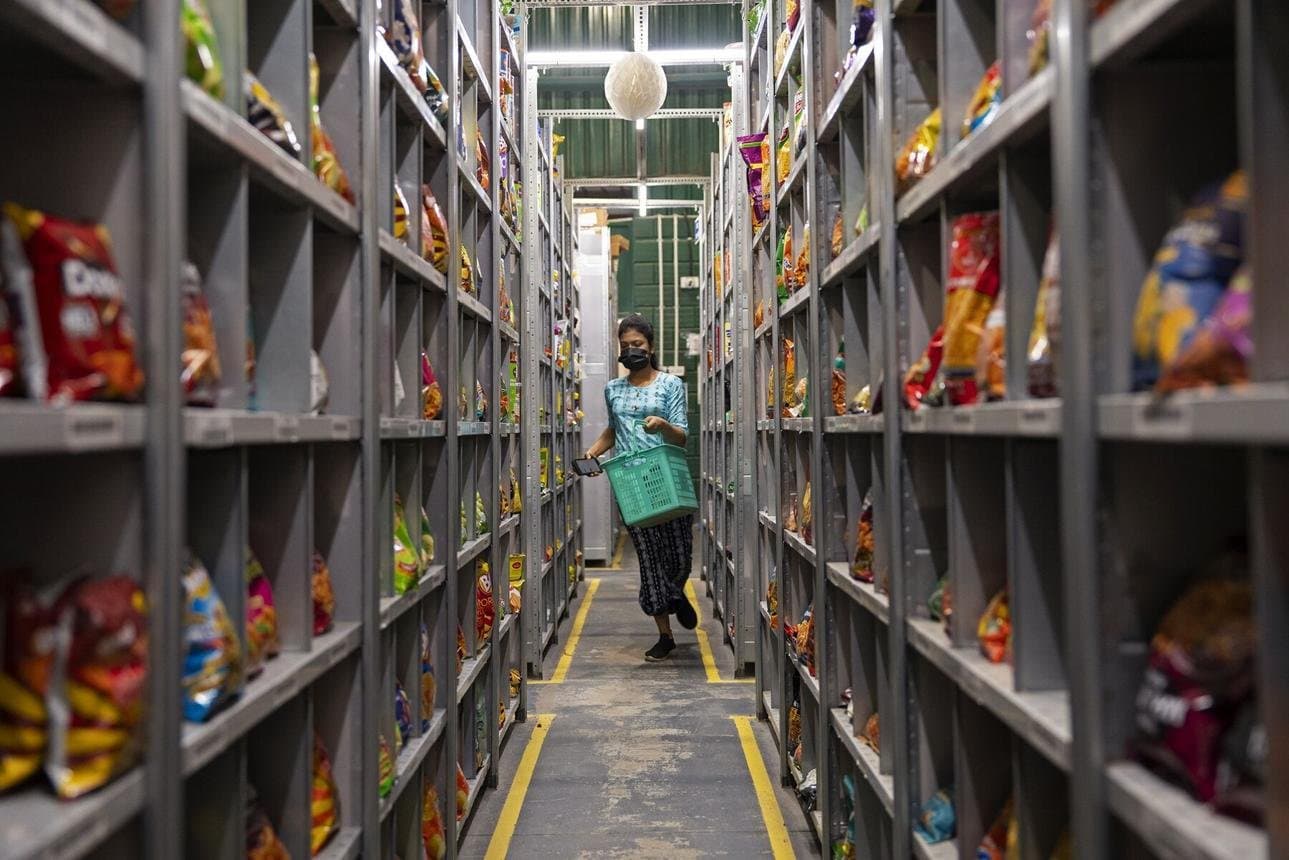
Dark stores are small warehouses located close to residential neighbourhoods. They do not depend on walk-in customers; their economics depend on how many orders they can process within a limited delivery radius.
Because rent, electricity, staffing, and inventory costs continue even when demand is weak, each store needs sufficient daily volume to absorb fixed expenses.
Store-Level Thresholds
Industry analysis reported by Business Standard indicates that:
- A large-city dark store may need approximately 1,200–1,300 orders per day to cover fixed expenses.
- A Tier-2 city store may need approximately 800 orders per day because rents are lower.
- Actual order volumes vary significantly by location, assortment, delivery radius, and customer density.
Eternal’s Q1FY27 disclosures provide a company-level example of how Blinkit evaluates store economics. Blinkit’s network had expanded to approximately 2,443 stores, while the company continued investing in larger stores, inventory, and supply-chain infrastructure. The relevant figures are available in Eternal’s Q1FY27 results.
The Batching Flywheel
Quick commerce platforms are increasingly grouping nearby orders into a single delivery run. A Business Standard report citing Datum Intelligence said average delivery costs of roughly ₹40–50 per order could fall towards ₹30 with batching. The actual saving depends on order density, delivery distance, and whether several orders can be served without delaying customers. The takeaway is simple: speed is expensive when orders are scattered, but density allows the same rider and dark store to serve more customers efficiently.
Lever 2: Basket Size
The second lever is increasing the average order value.
A larger basket helps platforms spread delivery, picking, packing, and dark-store costs across more products. However, there is no single publicly disclosed AOV at which every quick commerce platform breaks even. The required level depends on product mix, discounts, delivery charges, private-label sales, advertising income and store productivity.
Expanding Beyond Grocery
Staple items such as milk and bread generally offer less margin than private-label, prepared-food, beauty or electronics categories. Platforms are therefore expanding their assortment.
Electronics and mobiles: Flipkart Minutes is using electronics to raise order values. Financial Express reported that Minutes’ overall order value benefited from mobile-phone sales. The official Flipkart announcement on its micro-fulfilment network also described expansion into electronics, beauty, wellness and more than 120 categories.
Beauty and personal care: Beauty and personal care are becoming an important quick commerce category. Redseer’s analysis and its Brand Index research report strong growth in online beauty and personal-care purchases through quick commerce platforms.
Prepared food: Zepto Café is another example of a higher-frequency and potentially higher-margin category.
Lever 3: Advertising

Quick commerce platforms are increasingly becoming retail-media networks. When brands want their chips, soaps, beverages, or personal-care products to appear at the top of search results, they pay for visibility.
Advertising can be economically attractive because it monetises existing customer traffic without requiring the platform to buy, store or deliver an additional product.
Zepto’s Advertising Growth
Zepto’s advertising revenue increased 151% year on year to approximately ₹1,636 crore in FY26, according to Moneycontrol’s report on the company’s IPO disclosures. The figure represented approximately 7.2% of Zepto’s total operating revenue, with more than 2,400 brands using the platform’s advertising system. The same advertising figures were reported in Zepto’s updated IPO filing by The Economic Times.
Blinkit’s Advertising Fees
Blinkit seller and industry guides report listing fees of approximately ₹25,000 per product per state or cluster, along with additional advertising or placement commitments. However, these sources are not an official Blinkit rate card. The available secondary references include:
- Growww Tech’s Blinkit seller-cost guide.
- Decode Growth’s quick-commerce seller comparison.
- Global Websters’ Blinkit seller-registration guide.
The figure should not be treated as a universal Blinkit rate card. Blinkit’s commercial terms can vary by model and brand, and Growww Tech notes that the platform does not publicly publish a standard seller rate card.
The larger point is more important than the exact fee: quick commerce platforms can monetise brands not only through product economics, but also through paid visibility inside the shopping experience.
“Blinkit’s EBITDA breakeven isn’t a delivery story. It’s the moment a logistics platform became a media company.”
— Puneet Sharma, technology and retail analyst
Lever 4: Private Labels
Reselling established brands such as Nestlé or Britannia can leave platforms with limited margins after product costs, discounts, and fulfilment expenses. Private labels allow platforms to control sourcing, pricing, and product economics more directly.
Private-label examples include:
- Zepto: Zepto Daily and Relish.
- Swiggy Instamart: Supreme Harvest, Nectr and Noice.
- Blinkit: Whole Farm for fresh produce and kitchen staples
“I think Swiggy is starting to do that in a very interesting way with Noice. It gives you two things: customer acquisition as well as retention. People start coming to the platform for a particular SKU… I’m likely to buy the other four from Instamart as well.”
— Apoorve Goyal, MD, India Investments, Prosus
Conclusion: Fast Delivery Is the Hook, Monetisation Is the Real Business
Ten-minute delivery increasingly looks less like the entire business model and more like the customer-acquisition and habit-building layer around a broader commerce platform.
The companies that build sustainable economics will need to use fast delivery to build customer habits, while monetising those visits through advertising, private labels, denser dark-store networks, efficient batching, broader categories and larger baskets.