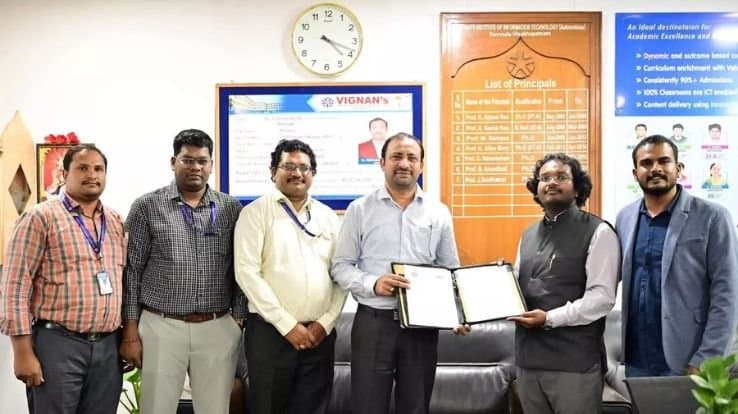
The event named “Weaving Innovations” concluded successfully at IIT Delhi at the Foundation for Innovation and Technology Transfer (FITT).
Recently, the IIT Delhi-hosted innovation challenge, Handloom Hackathon 2.0, concluded. It brought together startups, students, and innovators to develop practical solutions for strengthening India’s handloom ecosystem. Organized as part of the National Handloom Day celebrations, the initiative focused on developing tech-driven solutions to improve productivity, sustainability, and market access for handloom artisans.
The event reflected a growing recognition that technology today has the power to play an important role in preserving India’s rich handloom heritage while making the sector more competitive in modern markets.
All about practical and scalable innovations.
Participants worked on solutions across several priority areas, including design innovation, digital integration, sustainability, supply chain efficiency and financial inclusion for weavers. The hackathon encouraged ideas that could be implemented on the ground rather than remaining theoretical concepts.
Innovations presented during the finale explored ways to simplify production processes, strengthen digital marketplaces, improve product traceability and enhance access to financial services for artisans. Several teams also proposed solutions to help weavers connect directly with consumers through digital platforms while promoting environmentally sustainable practices.
An important bridge between technology and traditional crafts.
India’s handloom industry supports millions of artisans and remains one of the country’s largest traditional cottage industries. However, the sector continues to face challenges such as fragmented supply chains, limited market visibility, changing consumer preferences and restricted access to technology.
Events like Handloom Hackathon 2.0 seek to bridge this gap by encouraging collaboration between the technology ecosystem and traditional crafts. By involving engineers, designers, entrepreneurs, and researchers alongside handloom stakeholders, the initiative aims to develop solutions that improve productivity without compromising the authenticity of handmade products.
Beyond the competition, the hackathon served as a collaborative forum where discussions centred on modernizing the handloom sector through technology, entrepreneurship and sustainable business models. Selected finalists are also expected to receive incubation support to further develop promising solutions.
The conclusion of Handloom Hackathon 2.0 highlights the increasing role of innovation in addressing challenges within India’s traditional industries. Rather than replacing craftsmanship, the solutions showcased during the event aim to complement artisans’ skills by improving efficiency, expanding market reach, and strengthening livelihoods.