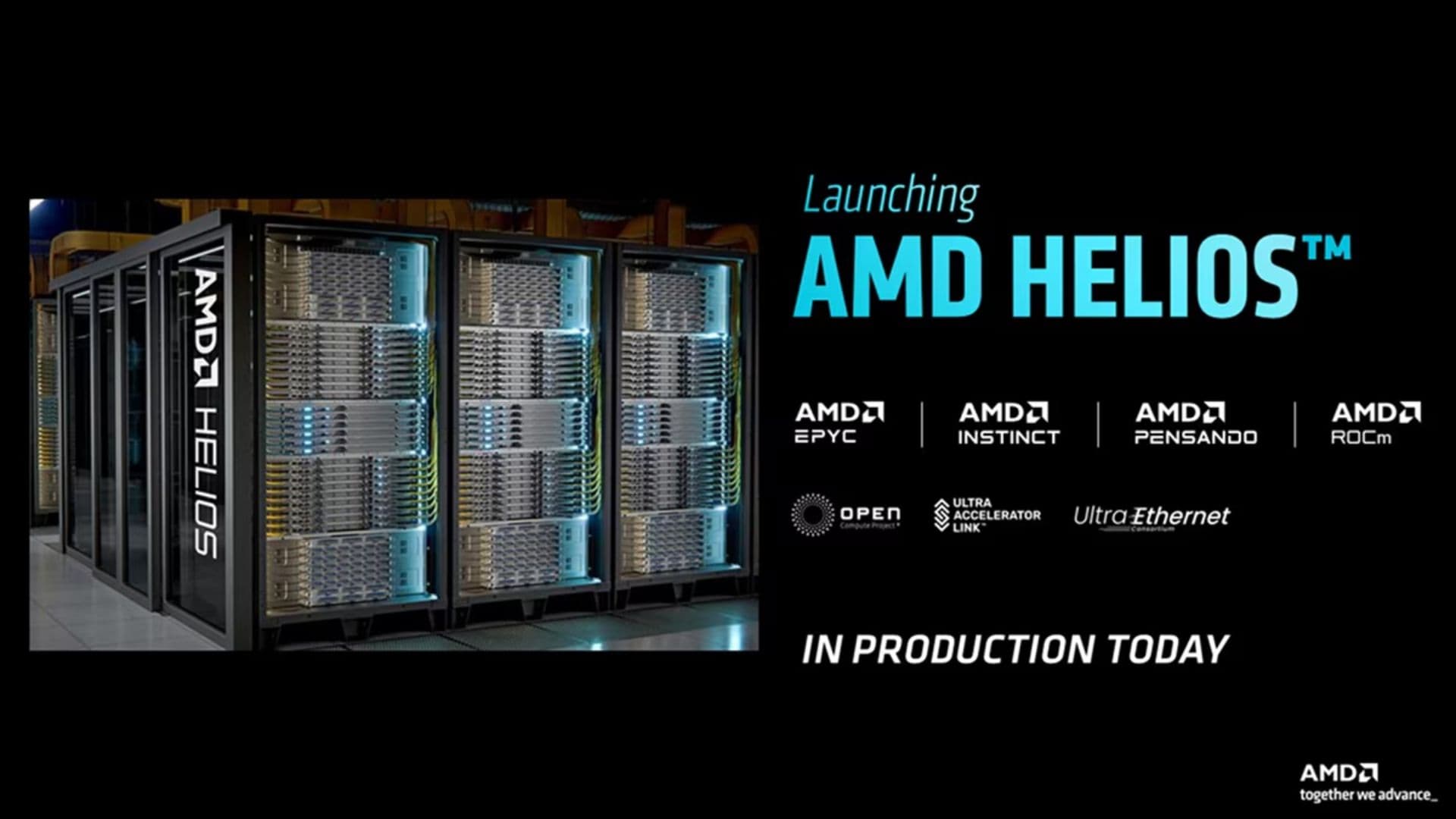
Microsoft, OpenAI, Meta, Oracle and Anthropic are among the first companies lining up to deploy AMD’s most powerful AI rack-scale platform yet
AMD unveiled its next-generation Helios AI rack-scale system on Thursday at its Advancing AI conference in San Francisco, marking its most aggressive push yet into the AI infrastructure market long dominated by Nvidia. CEO Lisa Su described Helios as the company’s highest-performance AI rack system to date, built to train and run the most demanding frontier AI models at scale.
Rack-scale systems represent the combination of many processors into one powerful unit that is used to train and run large-scale artificial intelligence (AI) models in data centers. Nvidia has had a clear lead in this field, as its Grace Blackwell and Vera Rubin systems are set to become the backbone of enterprise-level AI infrastructures. However, AMD is poised to challenge the company with its Helios design, which has shown to have key advantages over the Veri Rubin in specific areas, according to industry analysts.
Major Customers Already Committed
First unveiled in 2025 and shown again at CES 2026, Helios is set to begin shipping later this year. Microsoft plans to integrate the system into its Azure cloud infrastructure, while Anthropic has struck a strategic partnership with AMD to deploy up to two gigawatts of GPUs using the platform. OpenAI, Meta, and Oracle are also listed among the announced customers.
A New Chip Alongside Helios
AMD is also set to release its Venice-X processor, which is designed for data center and high-performance computing (HPC) workloads later this year. The company has slated its arrival in 2027 as part of its wider push into the AI hardware space.
A Market Set to Reach $1.4 Trillion
In her keynote, Su said the rise of agentic AI — systems that perform multi-step reasoning and repeatedly process information while completing tasks — is driving a sharp increase in computing demand. AMD now projects the global AI accelerator market will reach approximately $1.4 trillion by 2030, roughly the size of today’s entire semiconductor industry. Su added that GPUs will continue to dominate that market, as rapidly evolving AI algorithms favour flexible, programmable architectures over more fixed alternatives.